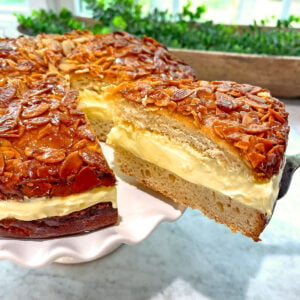
Authentic Bienenstich (German Bee Sting Cake)
This authentic German Bienenstich features honey caramelized almonds, a tender yeast cake, and creamy vanilla filling in every bite!
Equipment
- 10 inch springform pan (no smaller than this or the layers will be too thick)
- OR an 11 inch springform pan (thinner layers)
Ingredients
- For the Filling:
- 2 packets Dr. Oetker's vanilla pudding mix (**add 1/3 cup sugar when cooking the pudding, it's not pre-sweetened)
- OR 4.6 ounce box Jell-O Cook and Serve vanilla pudding mix (NOT instant, it won't work!) PLUS 2 teaspoons cornstarch when cooking the pudding
- 2 cups whole milk
- 1 cup heavy whipping cream
- 2 tablespoons powdered sugar
- **OR homemade Bavarian Cream (click link for recipe; you'll use one batch for the cake)
- For the Cake:
- 1/2 cup plus 1 tablespoon whole milk
- 5 tablespoons butter , at room temperature
- 2 3/4 cups all-purpose flour
- 1/3 cup granulated sugar
- 2 1/4 teaspoon instant yeast
- 1/4 teaspoon salt
- 1 large egg , at room temperature
- 1 teaspoon pure vanilla extract
- zest of one lemon
- For the Honey Almond Topping:
- 1/2 cup heavy cream
- 5 tablespoons butter
- 1/4 cup granulated sugar
- 1 1/2 tablespoons honey
- 1 cup blanched sliced almonds
Instructions
- Make the filling in advance because it will need to chill to set. This can be done a day in advance. If you're making your own filling from scratch, see my recipe for Bavarian Cream.If you're using a vanilla pudding mix you can either use 2 packets of Dr. Oetker's vanilla pudding mix or one family-size 4.6 ounce box of Cook and Serve Jell-O vanilla pudding (NOT instant, it will not work!). If using the Jell-O brand, add 2 teaspoons cornstarch to the powder mix. If using the Dr. Oetker brand do not add cornstarch but add 1/3 cup sugar (the mix isn't pre-sweetened). Use just 2 cups of milk for either brand. Follow. the packages instructions to cook the pudding. Let it cool and then chill for at least an hour, pressing plastic wrap on the surface of the pudding to prevent a skin from forming.After the pudding has chilled, add the cold heavy cream and powdered sugar to a large mixing bowl and beat until stiff peaks form (be careful not to over-beat). The chilled pudding will be very thick; use the electric beater to loosen it up. Fold the whipped cream into the pudding. Cover and chill for at least 2 hours or overnight.
- To make the cake: Scald the milk. This step is optional, but it's a technique used with yeast doughs to produce a softer crumb. Pour the milk into a small saucepan and heat it over medium heat, stirring frequently. Heat the milk until tiny bubbles appear around the outer rim of the saucepan. Do not let it boil. The milk is scalded when it reaches a temperature of 180-185 F. I recommend using an instant read thermometer. Add the butter to milk to melt it and let the mixture cool to room temperature.In the bowl of a stand mixer, add the flour, sugar, yeast, salt, and lemon zest. Add the milk mixture, egg, and vanilla extract.Use the dough hook attachment and knead the dough on "2" (medium speed) until the mixture comes together. Once a dough has formed, continue to knead for a full 10 minutes.Lightly spray a medium sized bowl with oil, form the dough into a ball, and place it in the bowl.Cover with plastic wrap and let it rise in a warm place until nearly doubled in size. How long this takes will vary according to your room temperature. But since this is an enriched dough, plan on minimum 90 minutes and as long as 2 1/2 hours. Don't go by the length of time, go by the size of the dough.
- Place the risen dough on a clean work surface and roll it into a circle the same circumference as your springform pan. In this case, a 10 inch circle. See Note below about springform sizes.I like to place a large piece of parchment paper on the bottom of my springform pan and then snap the rim in place, so that the parchment paper is sticking out around the pan and forms a barrier to catch any of the caramelized liquids. Grease the parchment paper and the springform pan. Place the round circle of dough into the springform pan.Cover the pan with plastic wrap and let the dough rise again in a warm place for 30 minutes. It's not going to rise very noticeably but will become a little puffier.
- While the dough is rising a second time, preheat the oven to 350 F/180 C and prepare the honey almond topping.Melt the butter, cream, sugar and honey in a small saucepan over medium high heat, stirring constantly until the sugar is dissolved. Bring it to a simmer and let it simmer for 2 minutes, stirring occasionally to prevent from burning.Turn off the heat and stir in the almonds. Stir to evenly coat them.Let the mixture cool for about 5 minutes (you don't want it to be so hot that it kills the yeast when you place it on the dough).Spoon all of the almond mixture and sauce on top of the dough in the springform.Spread the mixture out evenly over the entire surface of the dough, just to edges, doing your best to avoid letting it drip down the sides.Let the dough with the almond topping sit for 15 minutes.
- Bake the Bienenstich on the middle rack for 30 minutes or until it is a rich golden brown. Be careful not to over-bake it or the dough will be very dry.Allow the cake to cool in the pan for 5-10 minutes and then use a sharp knife to loosen the caramelized edges from the sides of pan. Remover the side of the springform pan and let the cake cool completely.Once the cake has completely cooled, use a large, sharp serrated knife to carefully cut through the middle of the cake, to create two layers.
- Place the bottom layer back in the springform pan.Add the filling: Scoop all of the vanilla pudding cream filling onto the bottom layer of the cake in the springform pan and smooth it out across the whole surface of the layer.The next step is critical: You must pre-slice the top layer of the cake. If you skip that step and then try slicing a piece of the cake, the pressure from pushing down on the top will cause the center filling to squish out.Place the top layer on a cutting board and cut it evenly into 8 equal triangular wedges. Next lay the pieces on top of the filling in the same order.Once you've placed the pieces of the top layer on the cake, cover it well with plastic wrap (lightly spray with oil to prevent it from sticking) or place it in an airtight cake saver, and refrigerate for at least 4 hours or overnight.Some people (though I've never seen a fellow German do it) give the cake a dusting of powdered sugar, but there's no good reason to do that - you want to see the beautiful glossy, caramelized honey topping that is the hallmark of Bienenstich!Remove the cake from the fridge, remove it from the springform, and transfer it to a serving plate or platter. Let the cake sit for about 30 minutes at room temperature before serving.
- Once assembled, Bienenstich is best enjoyed the same day. The filling requires refrigeration, and even if the cake is stored in a sealed container, yeast dough dries out in the fridge. If you don't have time to make and eat the cake the same day, make the cake, let it cool and wrap it well (lightly spray the plastic wrap with oil so it doesn't stick), store it at room temperature, and then cut and assemble it the next day to serve. The filling can likewise be made a day ahead and stored in the fridge (press plastic wrap down on its surface to prevent a skin from forming).
Notes
Springform Size: Use at least a 10 inch springform. Any smaller than this and you'll have thick layers of yeasted cake, which will make for a pretty dry mouthful. Use either 10 inch or you can also use an 11 inch springform pan. That will give you thinner layers, which is perfectly fine, it just takes some careful skill to cut the layers in half.
Storage: Once assembled, Bienenstich is best enjoyed the same day. The filling requires refrigeration, and even if the cake is stored in a sealed container, yeast dough dries out in the fridge. If you don't have time to make and eat the cake the same day, make the cake, let it cool and wrap it well (lightly spray the plastic wrap with oil so it doesn't stick), store it at room temperature, and then cut and assemble it the next day to serve. The filling can likewise be made a day ahead and stored in the fridge (press plastic wrap down on its surface to prevent a skin from forming).
Freezing: Bienenstich does not freeze well because the whipped cream and custard will separate when thawed. The cake would have to be frozen without the filling and have the filling added once thawed.
Nutrition
Calories: 638kcalCarbohydrates: 59gProtein: 13gFat: 40gSaturated Fat: 21gPolyunsaturated Fat: 3gMonounsaturated Fat: 12gCholesterol: 118mgSodium: 237mgPotassium: 334mgFiber: 4gSugar: 25gVitamin A: 1247IUVitamin C: 0.3mgCalcium: 169mgIron: 3mg
Tried this recipe?Let us know how it was!