
How To Make Yogurt

This post may contain affiliate links. See my disclosure policy.
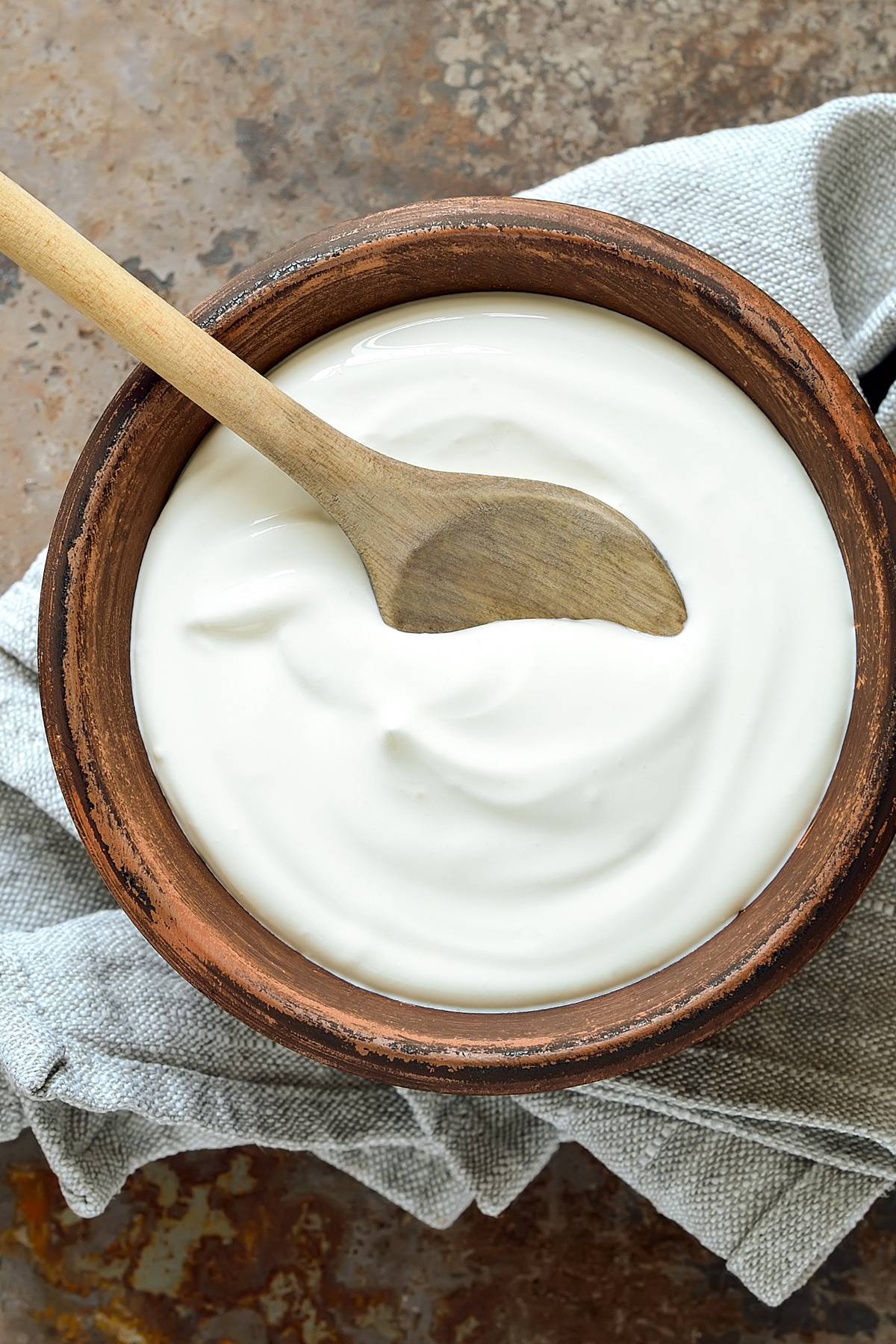
Whether you’re making regular or Greek yogurt, it’s time to learn How to Make Yogurt! It’s incredibly easy, requires virtually no prep work and the outcome will amaze you: Wonderfully thick, creamy, luxuriously delicious yogurt! This homemade yogurt recipe is SO good and SO easy, you’ll NEVER need to buy store-bought again!
Easy Homemade Yogurt
How long does it take to pour a gallon of milk into a slow cooker? That’s about how much hands-on prep time is involved in making this gloriously thick, rich, and creamy homemade yogurt! Making yogurt at home is surprisingly easy, economical, and gives you complete control over the ingredients and consistency. I’ll show you how to make regular yogurt or thick and creamy Greek yogurt. The choice is yours.
Why Make Your Own Yogurt?
I can’t remember the last time that I bought yogurt. I’ve been making my own yogurt for at least 10 years now and I love homemade yogurt because:
- It tastes great
- It costs less
- It contains live and active cultures
- I have full control over the ingredients and thickness
Making your own yogurt is easy and once you’ve gotten the hang of it you’ll likely never buy yogurt again either!
Homemade Yogurt Ingredients and Equipment
- Milk: For the richest, creamiest results, I recommend whole milk, although 2% and skim milk can also be used.
- Plain yogurt (as a starter culture): There is no need to buy a special yogurt starter culture. You can either use store-bought plain yogurt containing live cultures or a cup of yogurt from your previous homemade batch. If using store-bought be sure to check the label on the container confirm that it has l. bulgaricus and s. thermophilus in it. These live cultures are necessary in order for your yogurt to set.
- Cheesecloth: You’ll this for straining the yogurt. I use and recommend this cheesecloth because it’s 100% unbleached cotton, is high grade, is very durable for multiple uses, and you get a ton of it. Overall it’s the best value I have found for the quality.
- Thermometer: You’ll need a thermometer to check the temperature. Heating the milk to right temperature and then reducing it to the right temperature are both critical to the success of your yogurt.
- Large Pot or Slow Cooker: I like to use a slow cooker because of the hands-off convenience, bou can use either and I’ve provided instructions for both.
- Colander: You’ll need a colander for straining the yogurt through the cheesecloth. I like and use this one that hangs over the sink.

Slow Cooker vs. Stovetop: Which Is Better?
You can use either with great success. The best choice comes down to how much time you have and how hands-on you want to be.
Slow Cooker Method
Pros: The slow cooker heats the milk slowly and gently, which reduces the risk of scorching. It’s also wonderfully hands-off. You can let the milk heat over the course of a few hours while you go about your day.
Cons: It takes considerably longer to heat the milk than it does on the stovetop. Of course, that’s only a disadvantage if you’re in a hurry!
Stovetop Method
Pros: The stovetop method is much faster. You can bring the milk up to temperature relatively quickly, then simply wait for it to cool before adding the starter culture.
Cons: It requires more attention. As the milk gets hotter, you’ll need to stir it regularly to prevent scorching because the milk can burn surprisingly quickly if you’re not watching it.
Which method do I prefer? I’ve used both methods with success but I generally reach for my slow cooker because I love the hands-free convenience. I can plug it in and let the milk slowly heat while I go about my daily tasks.
Why Do You Have to Heat the Milk to 180°F?
A question you may be asking is, if I’m using store-bought pasteurized milk, do I need to heat it to 180 degrees or can I just skip that step? Even though grocery-store milk is already pasteurized, you should still heat it to approximately 180°F, then allow it to cool to around 110°F before adding the starter culture. Why? Because heating isn’t just about eliminating unwanted bacteria. High heat changes the structure of the milk proteins, helping the yogurt develop a thicker texture. I tested this myself. When I heated the milk to only a little over 110°F before adding the starter, it barely thickened. When I heated it to 180°F first, cooled it to 110°F, and then added the starter, it thickened beautifully. So don’t skip this step if you want reliably thick yogurt.
What is Whey?
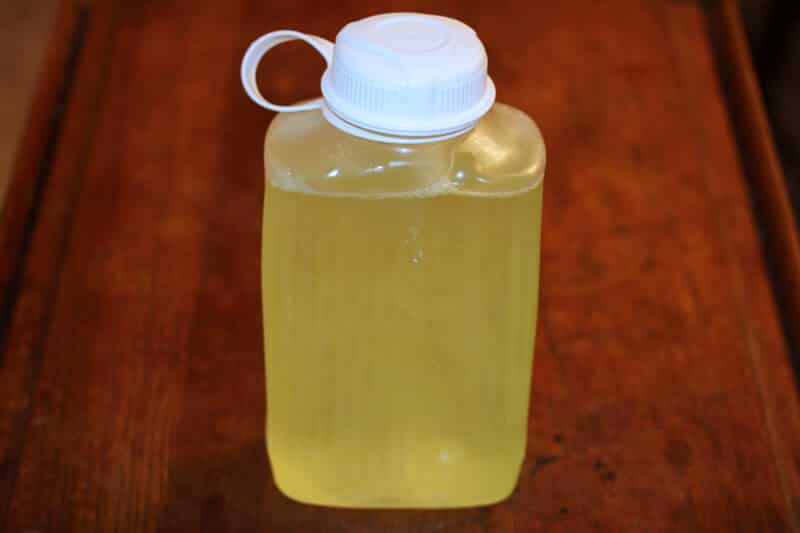
That yellowish liquid that’s left over after you strain the yogurt….that’s called whey. When making homemade yogurt, you’ll always end up with some whey as a by-product. The longer you strain the yogurt, the thicker it will get, the more whey it will yield. If you strain it to full capacity for an extra thick Greek yogurt, you’ll end up with about 8 cups of whey, but every batch will be different.
Whey is milk minus the fats and solids. It’s basically water with lactose and protein. And it’s the protein that’s the valuable ingredient here. Milk contains two types of protein, casein and whey. Most of the casein ends up in the yogurt and the whey is in the liquid by-product.
How to Use Leftover Whey
Whey is a good source of protein and is used in powdered form in protein shakes and protein bars. But how can you this leftover liquid whey? Here are a few ideas:
- Soups and broths: Use whey in place of some of the water for additional flavor.
- Bread and baking: Substitute whey for water in bread dough and certain baked goods.
- Smoothies: Add some to your favorite smoothie for a protein boost.
- Gardening: Because whey is acidic, appropriately diluted amounts can be used around acid-loving plants to lower the pH level of the soil.
Can You Freeze Whey?
Yes, it can be frozen for up to 6 months. Freezing it in smaller portions makes it easy to thaw only what you need.
Can I Make a Smaller Batch of Yogurt?
Absolutely. This recipe uses one gallon of milk, but you can easily cut it in half and use a half gallon instead. Remember that a gallon of milk won’t produce a gallon of strained yogurt. The final yield depends on how much whey you remove (the thicker you make your yogurt, the lower the final volume) and will give you something in the ballpark of 2 quarts. Homemade yogurt can generally be refrigerated for about two weeks. If you’re making a smaller batch, just remember to reserve enough plain yogurt to start your next batch.
How to Make Greek Yogurt
You don’t need a separate recipe for Greek yogurt. The difference is simply how much whey you strain from the finished yogurt. The longer you strain it, the thicker and more concentrated it becomes. Use a cheesecloth-lined colander and simply stop straining when the yogurt reaches the consistency you like.
Help! My Yogurt Didn’t Set
Every once in a while, a batch simply doesn’t thicken. I’ve made over 60 batches, and fortunately it’s only happened to me a couple of times. But it’s nonetheless disappointing when you’re expecting thick, creamy yogurt and instead get “yogurt soup!”
A failed set can happen for several reasons. Here are some common culprits:
- The milk wasn’t heated to the proper temperature.
- The milk was too hot when the starter was added, damaging the cultures.
- The milk became too cool during incubation.
- The yogurt wasn’t incubated long enough.
- Too much or too little starter was used.
- The starter yogurt didn’t contain sufficiently active live cultures.
Because yogurt depends on living bacterial cultures, even a seemingly perfect batch can occasionally behave differently. Live bacteria can be finicky and they kind of have a mind of their own. The only thing to do is try again with a new batch. But just because it failed turning into thick yogurt doesn’t mean you can’t still enjoy it.
Don’t Throw Out the “Yogurt Soup”!
A failed, thin batch doesn’t have to go to waste. Yogurt drinks, for example, are enjoyed throughout Europe and many other parts of the world, so your failed batch may simply have given you an opportunity to make something different! Here are a few ways you can turn it into a refreshing yogurt drink:
- Sweeten it with honey or maple syrup
- Add a favorite flavored syrup
- Blend it with fresh or frozen berries or your favorite fruit
- Using it as the liquid base for a smoothie
- Or instead of a drink, use it to make a cold soup like Tarator

How to Make Yogurt
Let’s get started!
IF USING A STOCK POT INSTEAD OF A SLOW COOKER: If you’re in a hurry or don’t have a slow cooker you can use a stock pot. Simply heat the milk in a large stock pot over low to medium heat. Just be sure to stir it regularly, especially as it gets hotter, to prevent the milk from scorching. Then follow the rest of the instructions as written.
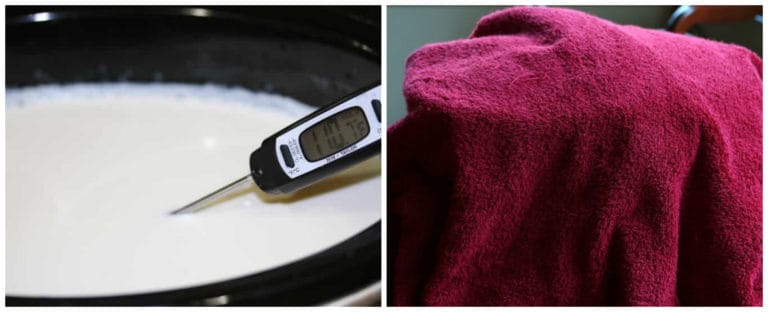
Pour the milk into the slow cooker and set it to HIGH. Go about your business, it’ll take at least 2 hours (usually longer) before the temperature’s up to 180 degrees. Use a thermometer to check the temperature.
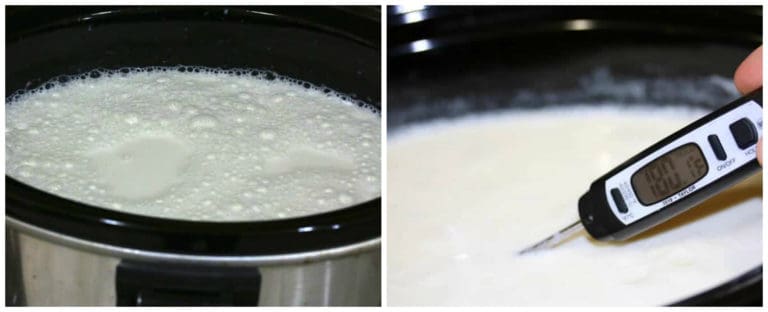
Once the temperature is up to 180 degrees, turn off the slow cooker or stove top and let the milk cool to 110 degrees F. Again, go about your business, this will take at least another 2 hours.
Once the temperature is 110 degrees, mix a little of the warm milk into the room temperature starter yogurt, then gently but thoroughly stir it back into the milk using up and down, left and right motions (not circular). Close the lid and turn off the slow cooker.
Wrap a large bath towel around the slow cooker and let it sit undisturbed in a draft-free, room temperature (or warmer) area for 10-12 hours or overnight. If the environment is too cool the yogurt will not set.
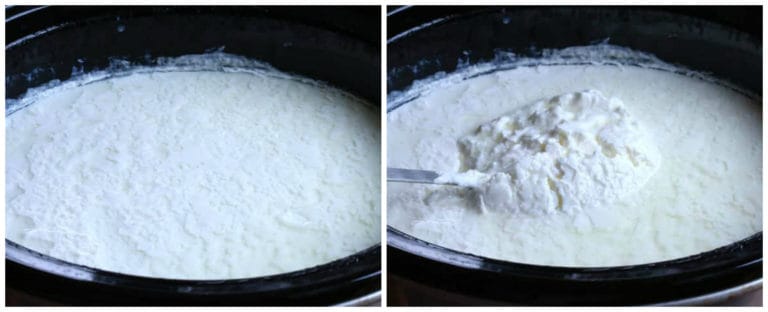
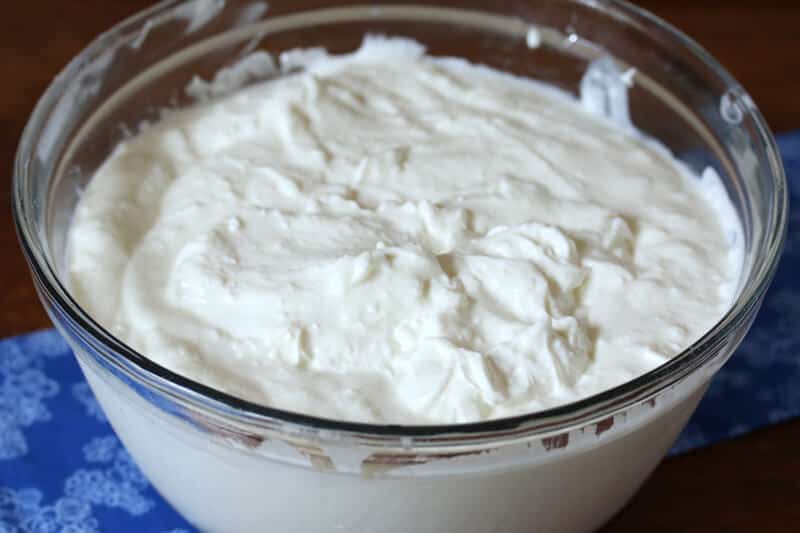
When you remove the lid you’ll find that the milk has thickened and the whey has separated.
Look at that fabulous thick texture! The transformation is almost magical. You’ll be so excited the first time you make this! I still get excited every time I lift the lid.
Line a colander with some cheesecloth.
I currently use this cheesecloth. It’s great quality and you get a lot of it for an excellent price.
Pour the yogurt into the cheesecloth. If it doesn’t all fit (depending on the size of your colander), let the yogurt strain until there’s room enough to add the remaining yogurt, then continue to strain.
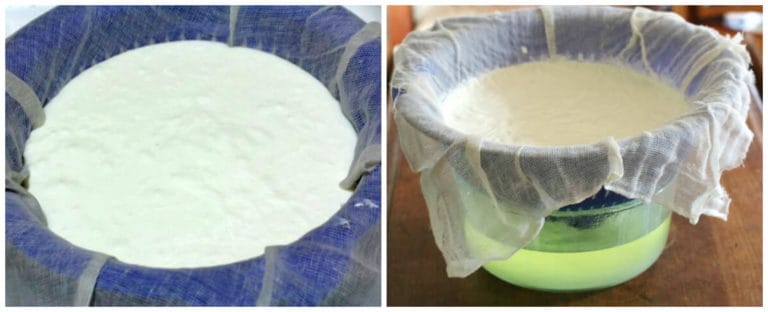
Depending on how thick you want the yogurt, this will take several hours. For thick Greek yogurt, you’ll end up straining it for at least 4 hours. That will also depend on the gauge of the cheesecloth. Set the colander on top of a large glass bowl. If leaving it to strain for several hours, you can put it in the fridge if you prefer and let it strain there.
See the liquid in the glass bowl above right? That’s whey. See the section above titled “How to Use Leftover Whey” for ideas.
Store the yogurt covered in the fridge for up to 2 weeks. When you’re ready to make another batch, use some of the previous batch for the starter culture.
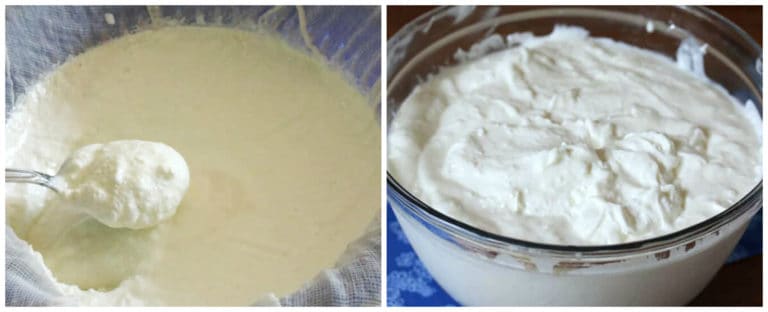
If fully strained to make Greek yogurt, you’ll end up with about 2 quarts (8 cups) of whey and 7-8 cups of Greek yogurt.
You’ll end up with less whey and more yogurt if you strain it less to make regular yogurt.
Cook with it, bake with it, eat it plain or with a variety of mix-ins, whatever your heart desires!
How Much Protein and How Many Calories Are in Homemade Yogurt?
There’s no single accurate answer because the nutritional content depends on the milk, starter, amount of whey removed, and final consistency. Straining removes water along with some lactose, minerals, and protein while concentrating the yogurt that’s left behind. As a result, calculating the calories and protein in homemade yogurt should be considered an estimate.
Ways to Enjoy Yogurt
There are so many ways you can enjoy your homemade yogurt. Here are just a few ideas:
- Add fresh berries or cut up fresh fruits to enjoy with your yogurt along with a sprinkle of cinnamon and/or a drizzle of honey or maple syrup for a healthy breakfast or snack.
- Make parfaits with fresh fruit and granola.
- Blend it with fresh or frozen fruit or with nuts, peanut/cashew/almond butter, chocolate, etc. to make smoothies.
- Add other ingredients and seasonings to use as a sandwich, toast or bagel spreads.
- As the base of a savory dip for oven-baked chips, bread or raw veggies.
- As the base of a sweet dip for fresh fruits or toasted cinnamon pita strips.
- Use it to replace some of the mayonnaise for making creamy dressings like ranch dressing, Russian dressing, thousand island dressing, creamy French dressing, blue cheese dressing and creamy cilantro dressing.
- Make homemade tzatziki sauce.
- Replace sour cream and buttermilk with yogurt in baked goods like cakes, muffins, waffles, pancakes or pie (e.g., sweet potato pancakes, pumpkin waffles, boxty, whole wheat sourdough waffles, sweet potato pie).
- Make yogurt fruit popsicles.
- Use it in place of sour cream for things like tacos, enchiladas and burritos.
- Use it to replace some of the mayonnaise for egg salad, tuna salad, chicken salad, Olivier salad, macaroni salad and potato salad.
The way I most commonly enjoy my yogurt is simply stirring in a spoonful of fruit preserves with a little powdered stevia for a healthy, low-carb treat to satisfy my sweet tooth. Another favorite way is to make vanilla yogurt by stirring in some high quality vanilla bean paste.
You’re going to love how rich and creamy this yogurt is – it’s almost like eating dessert!
Be sure to check out these other tutorials:
Save This Recipe
How To Make Yogurt
Equipment
- Slow Cooker , or large stock pot
Ingredients
- 1 gallon whole milk, 2% or skim milk (whole milk is recommended for thickest, creamiest results) (see note about using raw milk) *this method does NOT work with non-dairy alternatives
- 1 cup plain yogurt at room temperature , either from previous batch or store-bought (*The yogurt must have live cultures in it to work. Check the ingredients to make sure they include l. bulgaricus and s. thermophilus.)
Instructions
- IF USING A STOCK POT: If you're in a hurry or don't have a slow cooker you can use a stock pot. Simply heat the milk in a large stock pot over low to medium heat. Just be sure to stir it regularly, especially as it gets hotter, to prevent the milk from scorching. Then follow the rest of the instructions as written.IF USING A SLOW COOKER: Pour the milk into a slow cooker set to HIGH and close the lid. It will take 2-3 hours before the temperature of the milk is up to 180 degrees F. Check it with an instant-read thermometer. Once it's at 180 degrees, turn off the slow cooker, close the lid, and let the milk cool to 110 degrees F. This will take another 2-3 hours. Once the temperature is between 110 and 115 degrees F, add some of the warm milk to the plain yogurt, stir to combine, and then gently but thoroughly stir the mixture back into the milk in the slow cooker using up and down, left and right motions (not circular).
- Close the lid, wrap the slow cooker or stock pot with a large bath towel, and let it sit undisturbed in a non-drafty place at room temperature (or warmer) for 10-12 hours or overnight. If the environment is too cool the yogurt will not set. During this process the milk will have thickened and the whey will have started separating from the milk.
- Line a colander with a cheesecloth and pour the yogurt into it. Set the colander over a large glass bowl and let it strain at room temperature for several hours, until you've achieved the desired thickness (length of straining time will also depend on the gauge of the cheesecloth). For thick Greek yogurt plan on at least 4 hours. You'll end up with about 8 cups of whey and 7-8 cups of Greek yogurt.
- Store the yogurt in the fridge in an airtight container, preferably a glass bowl for up to 2 weeks. When ready to make another batch of yogurt, use a cup of the previous batch as the starter culture.
Notes
Nutrition
First published on The Daring Gourmet June 2017

Hi, I’m Kimberly Killebrew and welcome to Daring Gourmet where you'll find delicious originals, revitalized classics, and simply downright good eats from around the world! Originally from Germany, later raised in England, world-traveled, and now living in the U.S., from my globally-influenced kitchen I invite you to tour the world through your taste buds!

















Okay, Kimberly. I tried this, and discovered that the process is very forgiving. I do have two questions for you, though. The first one is, do you drain the yogurt at room temp or in the fridge? The second question is, do you stir it at all during the draining process? I ask because I left mine sit for 4 hours and while it was very solid, almost cheese-like against the cheese cloth, the rest of it was still pretty liquidy, and I did not get as much whey as expected. Apart from these questions, I was very pleased with how simple the process is. We already had some of the yogurt with our lunch and it was very nice. Not tart like fat-free yogurt is…
Hi Susan, I’m glad you enjoyed the yogurt. To answer your questions – Room temp or fridge for draining: It depends on how long I’m letting it sit. If it’s just 4 hours I let it sit at room temp. That also gives the probiotics longer to develop. I’ve actually let it sit out closer to 6 before as well. As for being thick around the edges but liquidy in the center – I’ve never seen that happen before so I’m afraid I can’t comment there. To answer your other question, no, I do not stir it during the draining process (I just spoon a little off to test its thickness), but whether you do or don’t really shouldn’t affect the outcome. It’s strange though that it would have remained liquidy in the center. When you say liquidy was it more liquidy than regular yogurt, or just not as thick as Greek yogurt?
Thanks for your answers, Kimberly. The center was just more like regular yogurt than Greek. But the outside was quite dry against the cheese cloth, almost like yogurt cheese. I will probably make another batch of yogurt next week and I think I’ll try stirring it once part way through the draining process. What has occurred to me is that the outside may become dry because we live in such a dry climate. I’ll just keep playing with it until I can figure out what I need to do, since it really is a simple process.
I had the same Problem and it only happens when I use a specific type of yogurt as my starter..Never happens when I use Stoneyfield whole milk yogurt. I think it does depend on the brand. Even though the Fage said it has all 5 ACTIVE LIVE cultures, sometimes it hasn’t worked.. so from now on I am sticking to Stoneyfield or one that someone who has consistently had good results…
Can this be made with 2% milk if preferred?
Hi Robin, yes it can. But before you do that, considering reading the article I link to in my first paragraph about full fat dairy :)
This is awesome! I made it this weekend and it came out perfect! I posted my experience to my blog and put up a link to your recipe. I also made your Beef Pepper Stew this weekend. The Greek yogurt goes great in that stew. :)
That’s wonderful, Jim! Thanks so much for the link, I really appreciate that. We love this homemade yogurt. I just finished another batch today. And the bath I made a few days ago I let strain extra long and have made a thick herbed cheese spread out of it – delicious! Thanks again, Jim, really appreciate the feedback!
Kimberly, Thank you so much for posting this. After my adventure with trying to find plain Greek yogurt at the grocery that wasn’t loaded with sugar – a miserable fail – I am now back on track with trying full-fat Greek yogurt. I’m curious to know, though, if the meat thermometer I have will work or if the instant read is a special one that I need to get. Thanks. Between Todd’s treatise on full fat dairy and your posting this recipe, it is clear that you two make a wonderful team.
Thank you, Susan :) I never buy yogurt anymore. This is much cheaper – and better – and the fact is, even though some of the store-bought stuff says it contains live cultures/probiotics, there’s really no way to verify that. Plus, I love the control this recipe gives me over the consistency. For example, if you prefer full fat yogurt with a higher protein content, simply strain it less so you don’t remove as much whey. Keep in mind, Greek yogurt isn’t better for you than regular full fat yogurt, it just tastes better (in my opinion) because it’s so rich and creamy. Adjust the straining time to meet your preferences for both consistency and protein content.
The thermometer: Yes, the meat thermometer will do perfectly fine. Instant read is just more convenient because it reads the results immediately when you’re needing to “catch” something at the right temperature. That said, there is wiggle room here by a few degrees. It doesn’t have to be exactly 180 or 110 by any means (though a little over 110 is better than under when adding the culture because the bacteria needs the warm temperature to grow).
Let us know how this turns out for you! I’m making another batch right now :)
Costco has no fat, low sugar ( 7 grams per 32 ounces) Greek yogurt. (Kirkland brand) We live on it.
You should avoid anything that is low or no fat. We now KNOW that fat is our friend, is more healthy, and reduces risk factors for CVD. The enemies are carbohydrate, sugar, and trans fat. There are many resources for those interested in the data, but the “Adkins/Mediterranean diets are all structured as high fat, low carb.
Thank you so much Kimberly .. another keeper <3
Thank you, Diana! :)
How long does this yogurt keep in the refrigerator? Can it be frozen?
Hi Ezekiel, most people say that it will keep for several weeks in the fridge but I’ve never let it sit that long, we usually eat it within 2 weeks. I’ve never tried freezing it but generally doing so will alter the texture as you thaw it (unless you’re eating it as frozen yogurt) as well as kill off some of the live bacteria.
I have frozen the yogurt and used as a starter. So, this reply had me concerned. I looked it up and this is what I found.
“The freezing process does not kill any significant amount of the cultures—in fact, during the freezing process the cultures go into a dormant state, but when eaten and returned to a warm temperature within the body, they again become active and are capable of providing all the benefits of cultures in a refrigerated …
Live and Active Culture (LAC) Yogurt Facts – National Yogurt Association”
The research that’s been done on this topic has demonstrated that some of the bacteria is killed, the question is how much – and on that point the research is unclear and divided. One professor at Rutgers University concluded, “So it’s possible, even likely, that frozen and thawed yogurt will contain living lactic acid bacteria, although it may only be 10% or 1% of the total number of bacteria that were there before the yogurt was frozen.” Another study cites a range of 40%-10%. So who knows.
And if you leave it in the strainer even longer you get a creamy cheesy product that you can add herbs to. You can form it into balls and put it into olive oil with any fresh herbs like rosemary and hot pepper flakes.
Yes, Marcia! I was actually already thinking of doing a separate post on that. It’s called Labneh, and is particularly popular in Lebanese cuisine.
During the time the slow cooker is covered by the bath towel, is the lid on or off?
Hi Karen, the lid remains on. Happy yogurt-making!
thanks for this recipe for home made yogurt. Can you tell me if this contains any probiotics or is it just a dessert?
thanks, Claudia
Hi Claudia, yes it contains probiotics. The purpose of adding the starter culture is to inoculate the milk with healthy bacteria which continues to multiply over the course of the 10-12 hours and beyond.
Kimberly,
I am anxious to try this recipe. I would like to have some flavoring to it however. What would you do to make it a tad sweeter and fruit flavored?
Hi, add everything at the very end after it’s drained and thickened (eg, stir in some honey and drained crushed fruit or berries). Otherwise anything you add earlier will interfere with the culturing process. Happy yogurt-making!
Hello Kimberly,
Thank you for the recipe and all detailed process for making home made yogurt.
Considering the proteíns in the whey, I decided skipping the draining step… I guess it is not a true Greek yogurt, but it turned out fine…
I actually used whole yogurt as the starter. I used 1.7 L of whole milk and 2 200ml of whole yogurt. The resultados this time was a thick yogurt. I added honey and everyone at home is enjoying it…thank you
Arnaldo Batista.
Hi Arnaldo, I appreciate your feedback, thank you. I don’t always make Greek yogurt either, I’ll do minimal draining for a more flowing yogurt. Adding honey and berries is probably my favorite way to enjoy it and the crowning touch is vanilla bean paste which I buy in bulk for the best deal. It makes for some amazing vanilla yogurt. Thanks again and here’s to many more batches of yogurt!
I made this weekend. Most AWESOME!!! Yummo! Just curious to see if you know what the calorie count is and how much protein per serving. Assuming a serving is 1/2 cup?
Hi Lisa, that’s terrific! Calorie count and protein content will depend on how much whey was removed in the straining process and there really isn’t a way to measure that. Even calories are hard guess because through the straining process the end product is much more condensed that the original milk.
Kimberly, Just wanted to send out a belated thanks for this wonderful recipe! I’m a yogurt fanatic and love it! I’ve made this recipe for months, using a store brand Greek yogurt for starter when I wasn’t sure if my homemade batch was still good. In addition, I’ve fallen in love with the labneh I’ve made from the yogurt. Well, a few days ago, I could find no “starter” in my small local market, except for the newer “Oui” by Yoplait. It’s a sweeter french-style yogurt. I wondered if it would make a sweeter cream cheese labneh, so I made your yogurt, then made the labneh. While I still like the usual Greek yogurt I obtain from a plain Greek yogurt starter, it makes delicious cream cheese. Some of my family did not like the tarter flavor of labneh made from Greek yogurt, but really liked the cream cheese made from the French-style yogurt. Spoons down and thumbs up!
Fantastic, Joyce, thanks so much for the feedback and also the info about the French-style yogurt!
Just tried this for the first time and it worked like a charm. Thank you.
Awesome, thank you, Bobbie!