
Authentic Stollen (German Christmas Bread)

This post may contain affiliate links. See my disclosure policy.
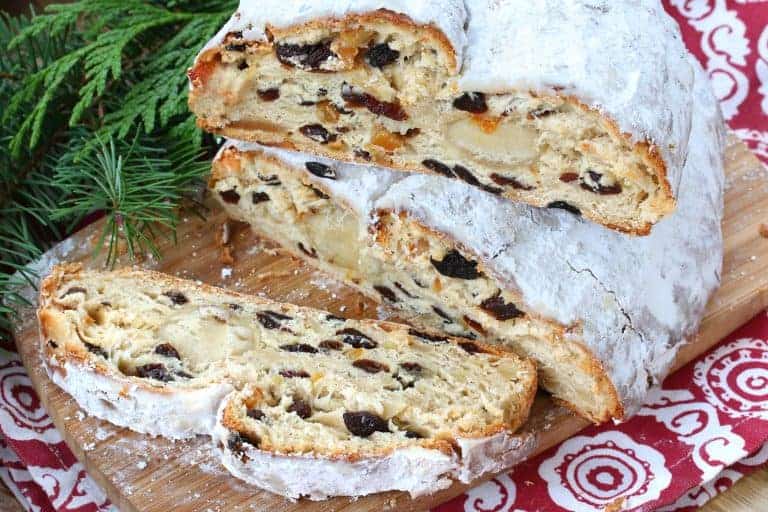
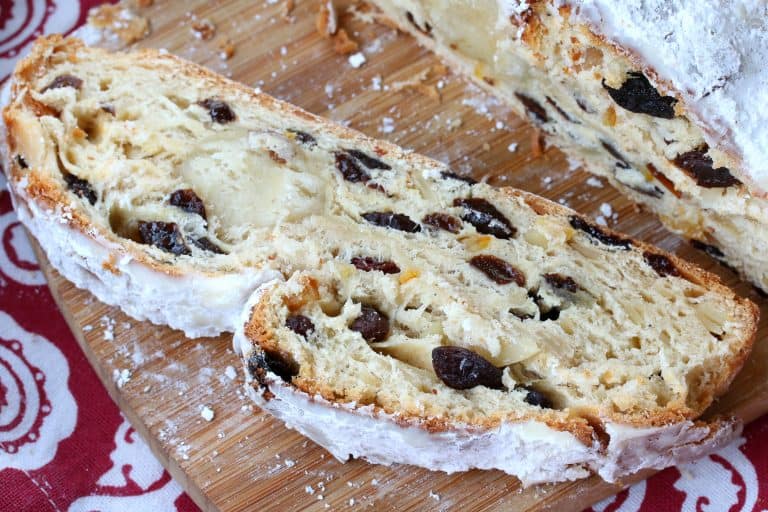
German Stollen have been around for nearly 700 years and are prized throughout the world as one of the most famous and beloved of all Christmas pastries. Made with homemade candied orange peel and marzipan (both super easy to make) your search for the BEST authentic German Stollen recipe has ended. Flaky, moist, and divinely flavorful, these homemade German Christmas Stollen are INCREDIBLE!
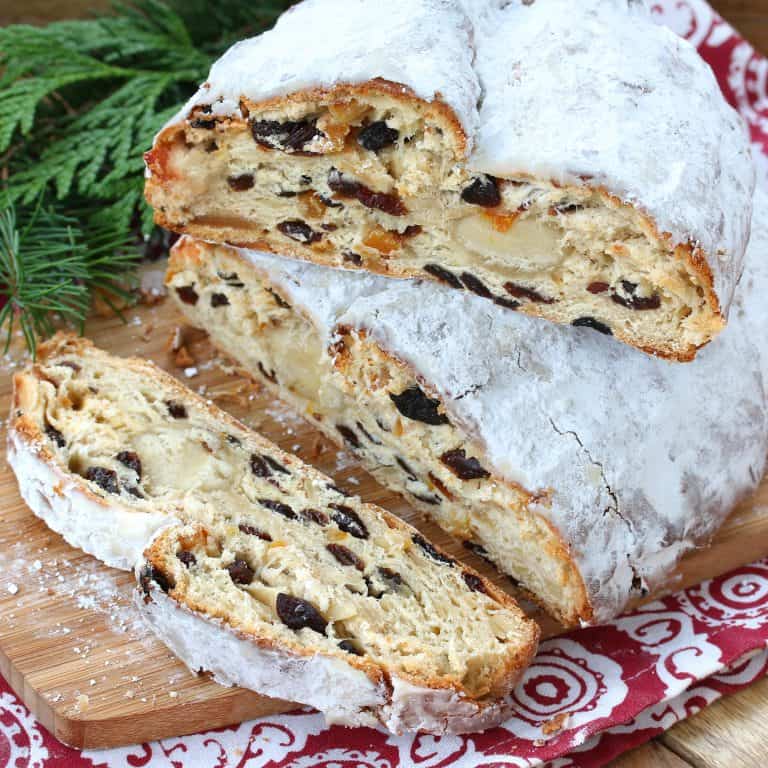
Sweet cakes and breads studded with candied fruits and nuts are hallmarks of Christmas baking in many areas of the world. Examples in the English speaking nations include fruit cake or Figgy Pudding, Scottish Dundee Cake, and then there is Panettone in Italy, keks in Poland, julekake in Norway, bolo-rei in Portugal, Hutzelbrot in Germany, and birnenbrot in Switzerland. But perhaps none are revered as highly throughout the world as German Stollen. I’m from southern Germany and celebrating the Christmas season without Stollen is simply unthinkable.
What is Stollen?
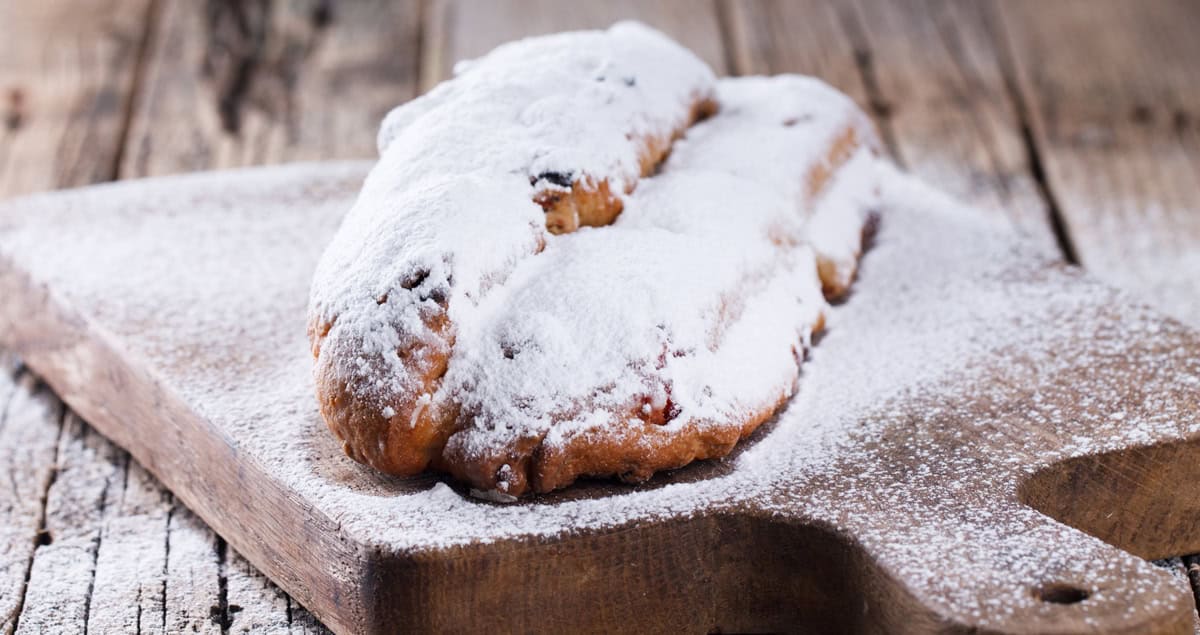
Christmas stollen, known in Germany as Christstollen or Weihnachtsstollen, is a yeasted fruit bread that is baked with dried fruits, candied citrus peel, nuts and spices. Stollen are baked free form into cake-like loaves that are folded in a sort of lopsided way that is characteristic of them. Stollen is sweet but it contains relatively little added sugar and instead derives its sweetness from the dried fruits and candied citrus peel. Stollen are famously dusted with a thick coat of powdered sugar, reminiscent of the snowy German landscape (like beautiful Ramsau by Berchtesgaden below), and baked with spices conveying the warmth of the Christmas season.

Where Did It Originate?
The first and most famous variety of stollen is the Dresdner Christstollen. Some historians date its concept back to 1329, and over the centuries the stollen was refined to become what it is today. And it has come a long way indeed because originally it was a bland and rather hard pastry as the use of butter and milk was forbidden during Lent by the Catholic church. Petitions were submitted to the pope, the first one in 1450, for permission to use butter for making the Stollen but it was denied. Fifty years and five popes later, Prince Ernst von Sachsen, at the request of the bakers of Dresden, petitioned the pope again to lift the butter ban. It was granted this time via the pope’s famous Butterbrief, “butter letter” – but only to members of the Prince’s household. A few select others were also granted permission but only on condition that they paid an annual sum of gold for the building of the Freiberg Minster.
The butter ban was once an for all lifted during the Protestant Reformation of the 16th century. From that point the stollen gradually developed into an enjoyable sweet bread incorporating additional ingredients and it become an important symbol of the region. King August II in 1730 commissioned the bakers of Dresden to bake a gigantic stollen in celebration of the strength of the Saxon military, an event to which he invited the dignitaries of Europe in the hope of building allies. The stollen weighed 1.8 tons (that’s 3600 pounds!), was 27 feet long and 18 feet wide and a special oven was designed and built just for this purpose. It took a convoy of eight horses to transport the stollen to the king’s table and a 26 pound and 5 1/4 foot-long knife was used to cut it.
Germany’s first Christmas market was held in Dresden in 1434. This market, the Dresdner Striezelmarkt, continues to be held every year. Also held annually on the Saturday prior to the 2nd Advent is the Dresdner Stollenfest featuring Germany’s largest Christstollen. So far 2013 holds the record for the largest Stollen weighing nearly 9400 pounds! Each year a horse-drawn carriage parades the giant stollen through the streets and on to the Christmas market. Per tradition, a replica of the original 5-foot long knife is used to slice the stollen. The mayor of the city tastes the first piece and the stollen is then cut into thousands of pieces that are sold with the proceeds going to charity.

The Symbolism Behind Stollen
The word “stollen” refers to a post or boundary stone for a city. It is also thought it could refer to the entrance of a mine shaft. Some historians believe that the stollen’s characteristic shape was molded after the shape of a mine tunnel, reflective of the silver and tin mining industries of the time. But there is also religious symbolism behind the stollen with the loaf, or bread, being symbolic of the body of Christ. Specifically, being dusted with powdered sugar, it is symbolic of the baby Jesus in swaddling clothes. Thus it is traditionally called Christstollen, or Christ Stollen.
Stollen Variations
Other popular variations of Stollen include Mandelstollen (almond stollen), Mohnstollen (poppy seed stollen), Quarkstollen (made with quark), Nuss-Stollen (nut stollen), Butterstollen (high butter content), Dresdner Stollen and Marzipanstollen (marzipan stollen). Mohnstollen is another one of my favorites.
How to Make the BEST Stollen
For anyone who may be feeling a little intimidated at the thought of making Stollen, don’t be. If you can make a cake or a loaf of bread, you can make Stollen. But while it’s easy to make, it’s not quick to make. There’s a waiting game involved both during the baking process and the aging process. In the baking process the Stollen dough has to rise a couple of times just like in making yeast bread. Then it has to bake for a while. And then there’s the waiting process.
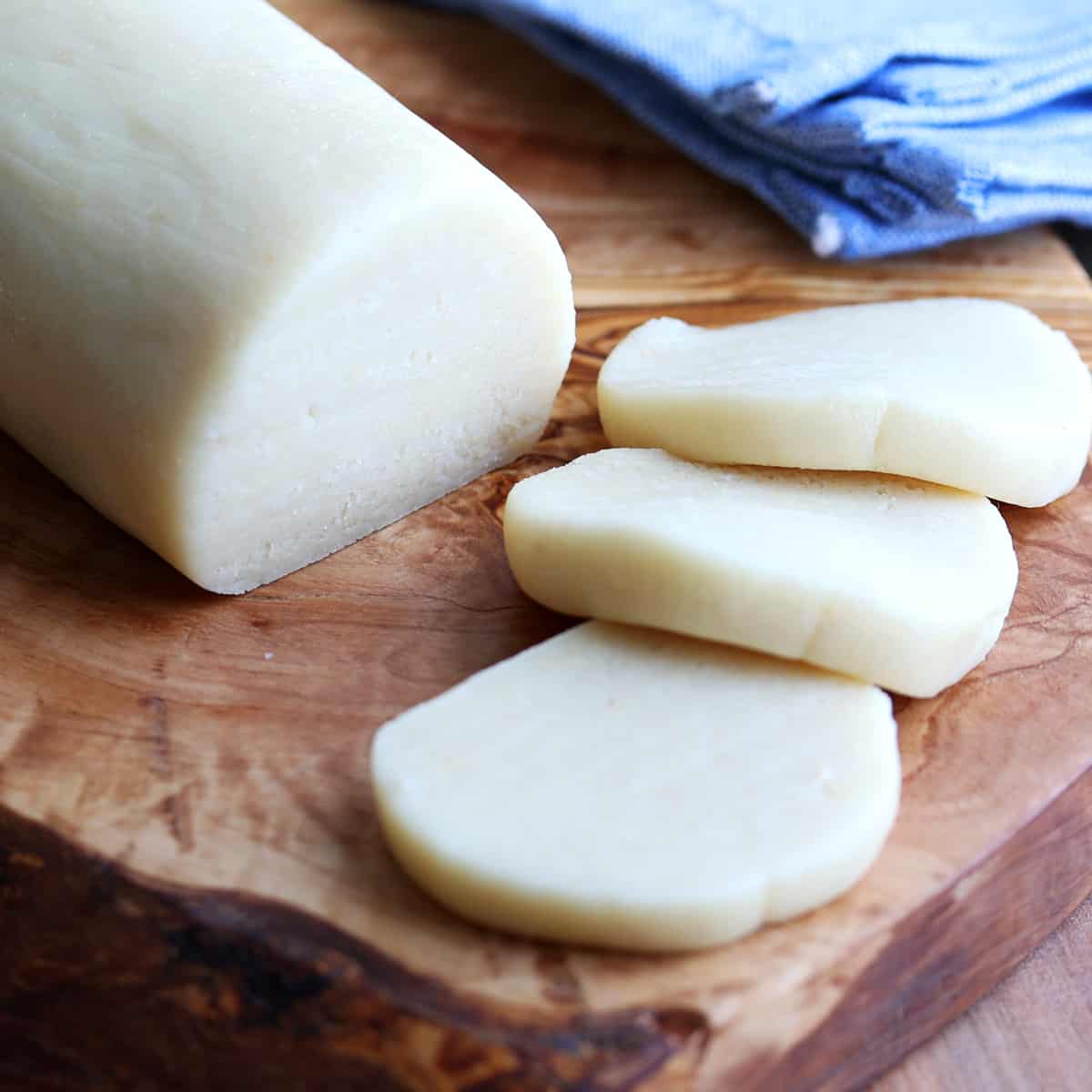
I’m sharing with you my recipe for Stollen which is thoroughly authentic in its method and ingredients. It features dried fruits, candied lemon peel, nuts and marzipan (which you can omit if you choose). I LOVE the addition of marzipan and it’s one of the most popular varieties of Stollen. Don’t worry about having to go out and buy marzipan, it is unbelievably quick and easy to make your own (seriously, it takes about 5 minutes). Check out my recipe for easy homemade Marzipan!
Candied Citrus Peel. Do you hate store-bought candied orange and lemon peel as much as I do? I have to tell you, I absolutely detest store-bought candied citrus peel. And most people I speak to feel the same. It has a bizarre chemical flavor no matter the brand. For that reason I’ve never been a fan of fruitcakes in general. BUT (and there’s a big but) using your own homemade candied citrus peel is a 100% deal changer.
While you can use store-bought candied citrus peel if you insist, I VERY, VERY STRONGLY recommend making your own. Please, trust me on this: Using homemade candied citrus peel is the difference between night and day when it comes to flavor! It is vastly superior in every way and will make your Stollen taste incredible! And the good news is it can be made far, far in advance. In fact, I freeze mine so it lasts basically forever and I take out what I need as needed. Check out my recipe for Candied Orange Peel!

Storage Tips
Typically the Stollen is tightly wrapped and kept in a cool place to age for 2-3 weeks before eating. This allows the liquid from the rum-soaked dried fruits to soak into the bread creating both flavor and moistness.
Fun trivia: Fruitcakes that contain a lot of alcohol can remain edible for years. Yes, years. For example, the Antarctic Heritage Trust discovered a 106-year-old fruitcake last year and after sampling it (the brave souls) they said it was not only in “excellent condition” for its age but was even “almost” edible! Another fruitcake baked in 1878 in Michigan was kept as a family heirloom and sampled for the first time in 2003 by Jay Leno on The Tonight Show. It’s amazing what an incredible preservative alcohol is. So in other words, as long as you keep your Stollen tightly wrapped and in a cool place, letting it age for 2 weeks is, like, nothing.
Does Stollen have to be aged? No! While letting Stollen age will allow the flavors to fully penetrate the bread, this Stollen is absolutely AMAZING straight out of the oven! So the question of whether to wait or not to wait I’ll leave up to you.
If you’ve never been a huge fan of store-bought Stollen you’re not alone. I’ve never cared for them either. But homemade…that’s an entirely different story. Just check out the hundreds of rave reviews below: Your search for the BEST Stollen recipe has ENDED.
Authentic German Stollen Recipe
Let’s get started!
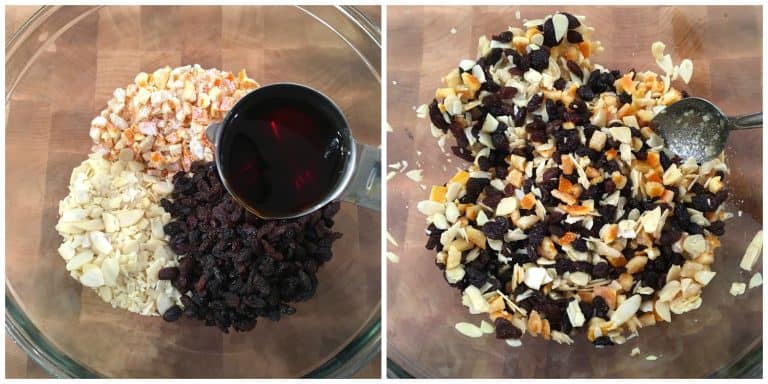
Place the raisins, candied citrus peel and almonds in a medium bowl and pour the rum over it. Stir to combine. Set aside and let the fruit mixture soak in the rum while the dough rises.
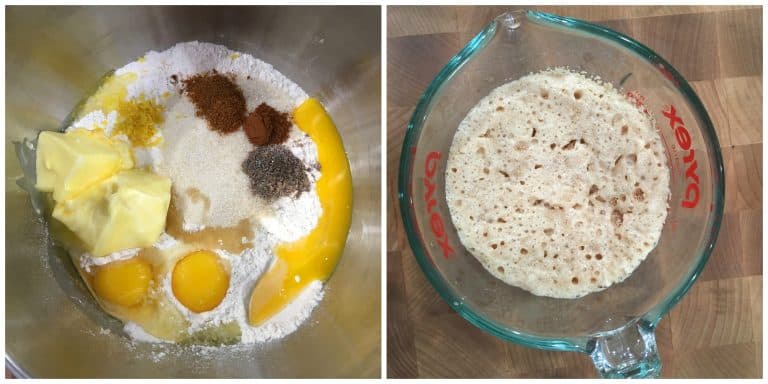
Stir the yeast and 2 tablespoons of the sugar into the lukewarm milk and let sit in a warm place for 10-15 minutes until very frothy.
Place the flour, remaining sugar, egg, egg yolks, butter, vanilla extract, lemon zest, salt, cardamom, mace and cinnamon in the bowl of a stand mixer fitted with a dough hook. Add the yeast/milk mixture.
Use a spoon to stir the mixture until it comes together. Knead the dough on the bread setting and once the dough comes together continue to knead for 7 minutes.
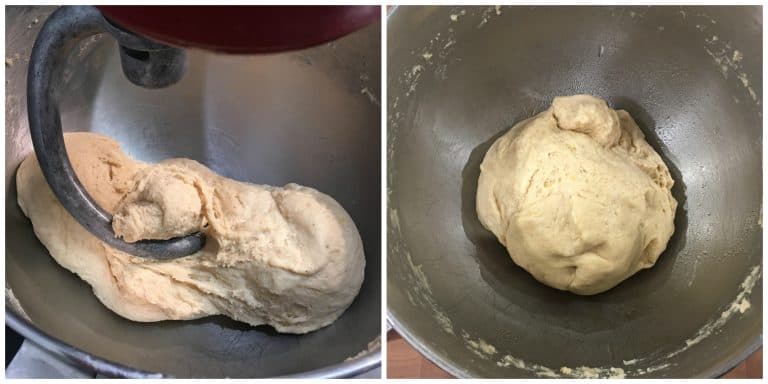
Remove the dough ball, lightly spray the bowl with a little oil, return the dough ball, cover loosely with plastic wrap and place it in a warm place or lightly warmed oven (just barely warm), to rise until nearly doubled in size, at least 1 hour.
Punch down the dough and add the soaked fruit/nut mixture to the dough (it should have absorbed all the rum by now but if there is excess liquid, pour it out before adding the mixture to the dough).
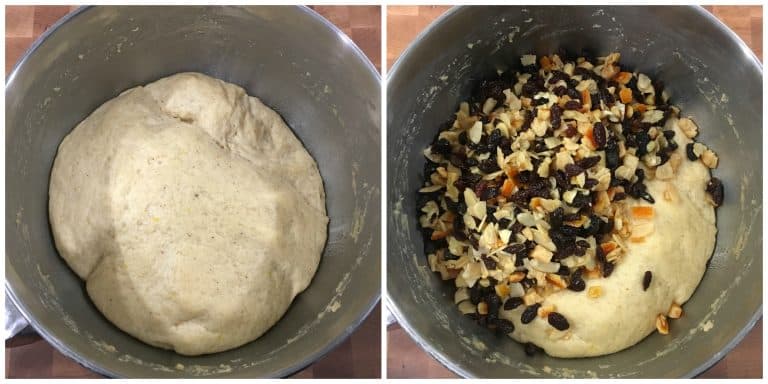
Using the dough hook, knead the fruit/nut mixture into the dough until combined. If the dough is too wet to handle, add a little bit of flour until the dough pulls away from the sides of the bowl. Note: I use my Kitchenaid stand mixer because it’s such a workhorse. You’ll also need a dough hook attachment. There are other pricier options on the market but I’ve been very happy with my Kitchenaid.
Turn the dough out onto a floured work surface.
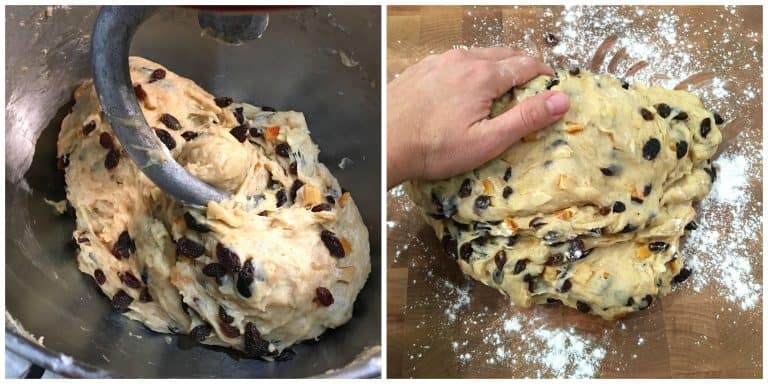
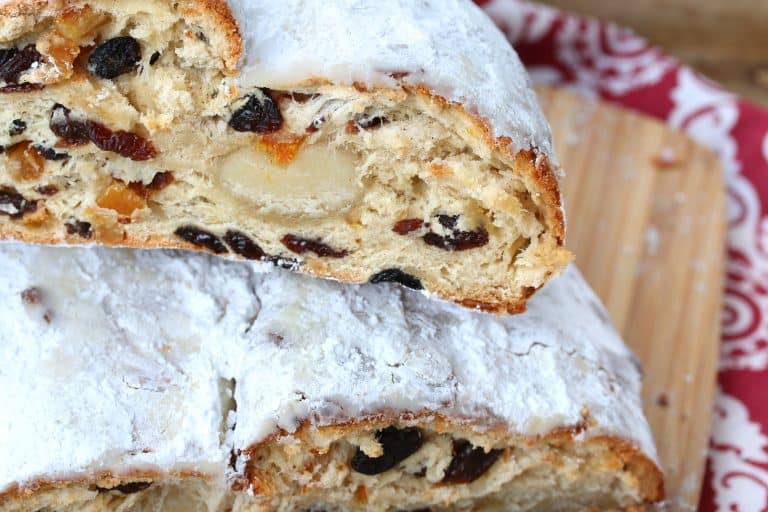
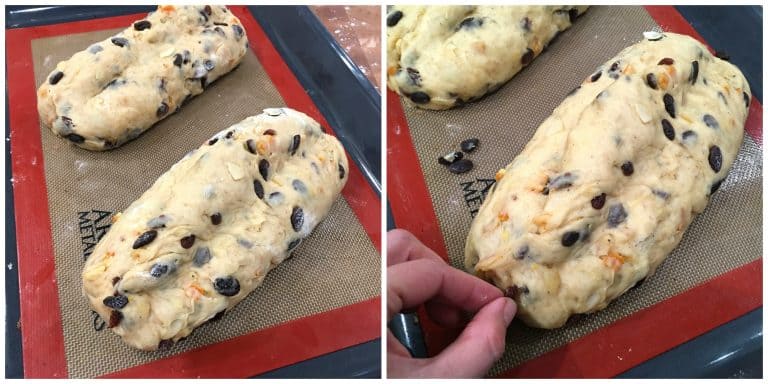
Cut the dough in two equal halves. Press or roll each piece into an oval to about 1 inch thickness. Roll each piece of marzipan into a log the length of the oval. Press the marzipan gently into the middle of the dough.
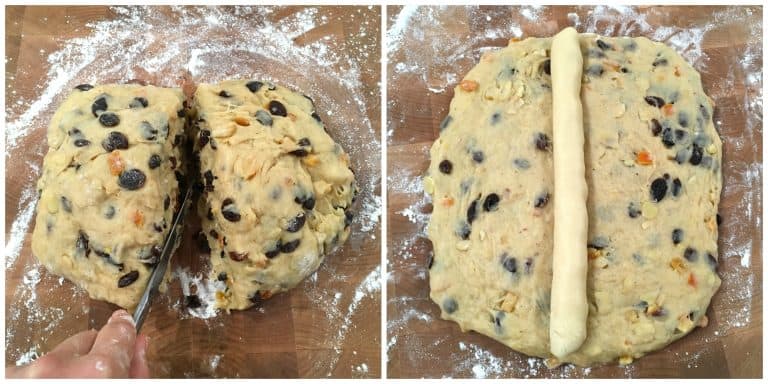
Fold the left side of the dough over to cover the marzipan, then fold right side over on top of the left side so that the edge of it sits just left of the middle of the stollen. In other words, don’t fold the right side all the way over to the left edge of the stollen.
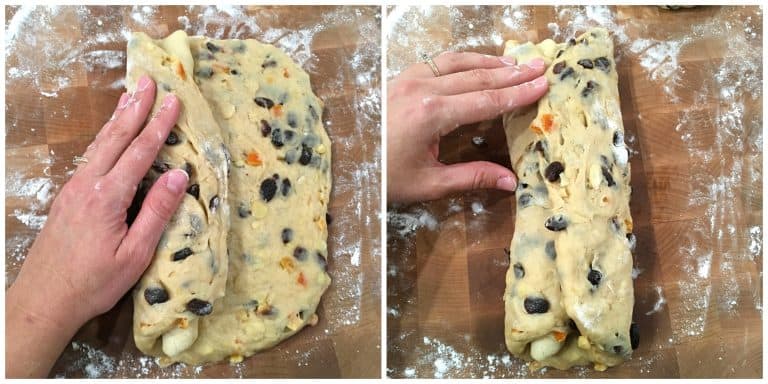
Pinch and tuck the top and bottom ends of the stollen to cover the marzipan.
Use the bottom edge of your hand to press down along the length of the stollen towards the right of the center to create a divot and characteristic hump.
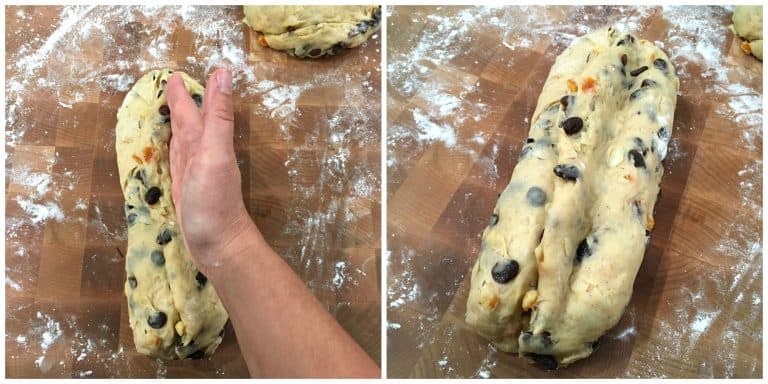
Place the stollen on a lined baking sheet. Cover the stollen loosely with plastic wrap and let them rest in a warm place or lightly warmed oven for 40-60 minutes until puffy.
At this point you can pick off any raisins that are sticking out of the dough (they will burn during baking).
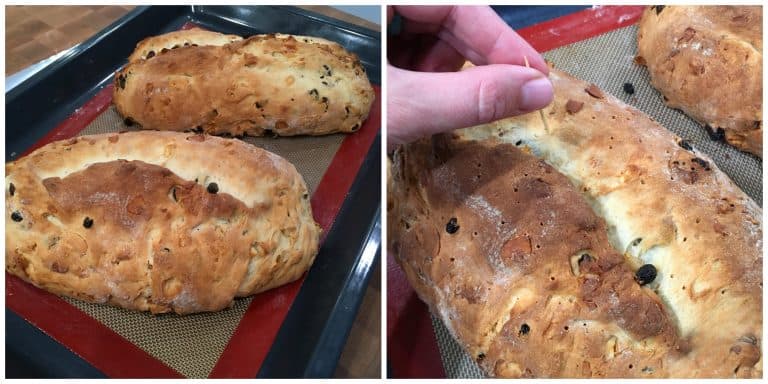
Towards the end of the last rise, preheat the oven to 350 degrees F and bake the stollen for 30-40 minutes or until golden. You can use an instant read thermometer (I love )to aim for an internal temperature of 190 degrees F.
Let them sit for 5 minutes, then use a toothpick to poke holes all over the stollen. This will allow the melted butter to seep in.
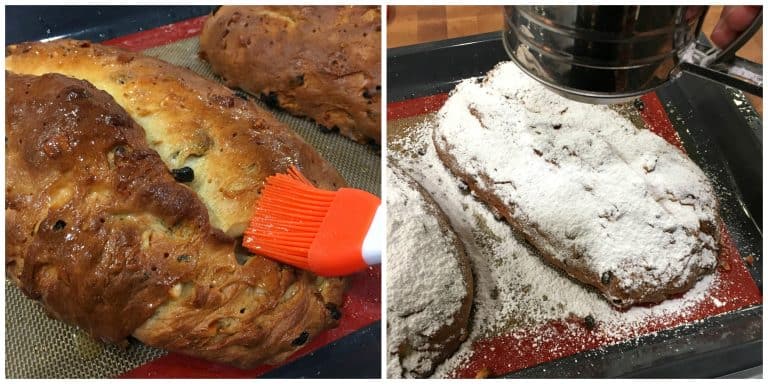
Generously brush the stollen with the melted butter while the stollen are still warm.
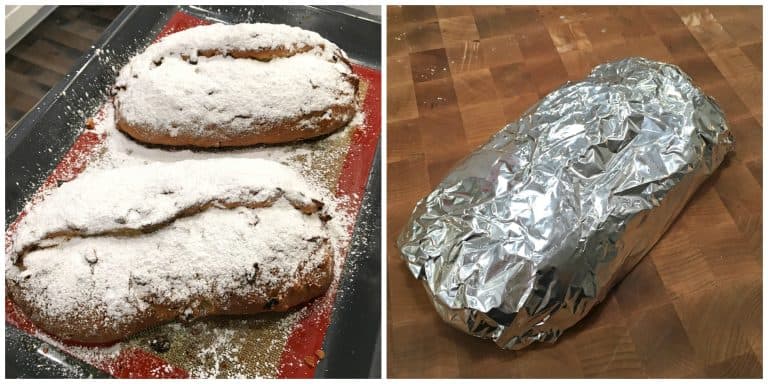
Immediately sprinkle with a generous amount of powdered sugar, rubbing it into the creases and down the sides. Let the stollen cool completely.
The stollen can be sliced and eaten now or wrapped tightly (I like to wrap in plastic wrap then foil) and left to “ripen” in a cool place for 2 weeks. The liquid from the dried fruits will further penetrate the dough for more flavor and moisture.
Stollen can also be frozen for longer storage.
For eating, I like to warm the slices up for a few seconds in the microwave, it makes the crumb nice and soft.
Enjoy!
How to Make Gluten Free Stollen
I’m often asked “can I make this gluten free?” Yes, you can make gluten free stollen and I’ve had a several readers report back with success following the same method and simply substituting the flour 1:1 with GF flour. Follow all the same steps, including the rising time, though gluten free dough won’t rise to the same extent. It also won’t have the elasticity that regular dough has so be prepared to use a bench scraper as needed to help shape the dough. Be careful to drain the soaked fruits to eliminate as much excess liquid as possible and be prepared to add a little extra flour as needed until the dough is a workable consistency.
For more traditional German Christmas goodies try my:
- Pfeffernüsse
- Lebkuchen
- Springerle
- Gugelhupf
- Printen
- Speculoos
- Vanillekipferl
- Zimtsterne
- Kokosmakronen
- Magenbrot
- Bethmännchen
- Heidesand
- German Rum Balls
Save This Recipe
Authentic Stollen (German Christmas Bread)
Ingredients
- For the Dough:
- 1 cup lukewarm whole milk
- 3 teaspoons active dry yeast
- 1/2 cup granulated sugar
- 4 to 4 1/2 cups all-purpose flour plus more as needed NOTE: Amount will vary depending on how much liquid is retained in the soaked dried fruit. Be sure to drain any excess liquid. Add more flour as needed if dough is too wet. (Gluten free, substitute 1:1 GF flour.)
- 1 large egg
- 2 large egg yolks
- 3/4 cup unsalted butter (1 1/2 sticks) , at room temperature so it’s very soft
- 2 teaspoons quality pure vanilla extract
- zest of one lemon
- 1 teaspoon salt
- 3/4 teaspoon ground cardamom
- 3/4 teaspoon ground mace (recommended but can substitute nutmeg)
- 1/2 teaspoon ground cinnamon
- 8 ounces Homemade Marzipan/Almond Paste , divided in half (you can omit the marzipan if you prefer)
- or store-bought marzipan/almond paste
- For the Fruits & Nuts:
- 9 ounces raisins
- 3 ounces candied lemon peel , finely diced
- 3 ounces candied orange peel , finely diced
- Homemade Candied Citrus Peel Recipe (we VERY STRONGLY recommend using homemade, it makes ALL the difference!)
- 3 ounces blanched slivered or sliced almonds , finely chopped
- 1/3 cup quality dark rum
- For the Glaze & Dusting:
- 1 stick unsalted butter , melted
- powdered sugar for generous dusting
Instructions
- Place the raisins, candied citrus peel and almonds in a medium bowl and pour the rum over it. Stir to combine. Set aside and let the fruit mixture soak in the rum while the dough rises.
- Stir the yeast and 2 tablespoons of the sugar into the lukewarm milk and let sit in a warm place for 10-15 minutes until very frothy.
- Place the flour, remaining sugar, egg, egg yolks, butter, vanilla extract, lemon zest, salt, cardamom, mace and cinnamon in the bowl of a stand mixer fitted with a dough hook. Add the yeast/milk mixture. Use a spoon to stir the mixture until it comes together. Knead the dough on the bread setting for 7-8 minutes. Remove the dough ball, lightly spray the bowl with a little oil, return the dough ball, cover loosely with plastic wrap and place it in a warm place or lightly warmed oven (just barely warm), to rise until nearly doubled in size, at least 1 hour (likely closer to 2 hours depending on the temperature of the environment).
- Punch down the dough and add the soaked fruit/nut mixture to the dough (it should have absorbed all the rum by now but if there is excess liquid, pour it out before adding the mixture to the dough). Using the dough hook, knead the fruit/nut mixture into the dough until combined. If the dough is too wet to handle, add a little bit of flour until the dough pulls away from the sides of the bowl.
- Turn the dough out onto a floured work surface and cut it in two equal halves. Press or roll each piece into an oval to about 1 inch thickness. Roll each piece of marzipan into a log the length of the oval. Press the marzipan gently into the middle of the dough. Fold the left side of the dough over to cover the marzipan, then fold right side over on top of the left side so that the edge of it sits just left of the middle of the stollen (see pics). In other words, don’t fold the right side all the way over to the left edge of the stollen. Pinch and tuck the top and bottom ends of the stollen to cover the marzipan. Use the bottom edge of your hand to press down along the length of the stollen towards the right of the center to create a divot and characteristic hump (see pics). Place the stollen on a lined baking sheet. Cover the stollen loosely with plastic wrap and let them rest in a warm place or lightly warmed oven for 40-60 minutes until puffy. At that point you can pick off any raisins that are sticking out of the dough (they will burn during baking).
- Towards the end of the last rise, preheat the oven to 350 degrees F and bake the stollen for 30-40 minutes or until golden. You can use an instant read thermometer to aim for an internal temperature of 190 degrees F. Let the Stollen sit for 5 minutes, then use a toothpick to poke holes all over the stollen (this will allow the butter to seep in), then generously brush the stollen with the melted butter while the stollen are still warm. Immediately sprinkle with a generous amount of powdered sugar, rubbing it into the creases and down the sides. Let the stollen cool completely. You may want to give it another dusting of powdered sugar once cooled.
- The stollen can be sliced and eaten now or wrapped tightly (wrap in plastic wrap then foil) and left to "ripen" in a cool place for 2 weeks. The liquid from the dried fruits will further penetrate the dough for more flavor and moisture. Stollen can also be frozen for longer storage.
- Makes 2 large or 3 medium Stollen.For eating, I like to warm the slices up for a few seconds in the microwave, it makes the crumb nice and soft.
Nutrition
Originally published on The Daring Gourmet November 20, 2018

Hi, I’m Kimberly Killebrew and welcome to Daring Gourmet where you'll find delicious originals, revitalized classics, and simply downright good eats from around the world! Originally from Germany, later raised in England, world-traveled, and now living in the U.S., from my globally-influenced kitchen I invite you to tour the world through your taste buds!

















Looks fantastic! I love the photos tutorial you’ve included. Your great instructions will hopefully lead to a successful first attempt in making stollen for me. Thank you!
My dad’s family is Austrian and my mom’s is German, so stollen is a well-known Christmas institution in our house. My dad is making a smattering of German recipes for Christmas this year (schnitzel and spaetzle are on the docket), and he asked me to bring stollen. I am beyond thrilled to find this recipe, and I hope mine will taste half as good as yours looks! Thanks so much for this.
That’s exciting, Becca, happy baking and please let us know what you think!
Kimberly, this is pure heaven in every bite, the best I have ever eaten. It was a huge hit with everyone. My mouth waters just thinking I should eat just one more piece. Wrapped one to ripen, but do not think that is going to happen, guess I am going to have to make more. You out did yourself, anyone thinking of making this stollen, stop thinking and get cooking, your recipe title is perfect, Best Authentic German Stollen is the best. Question, my local paper had an interesting article about a German cookie (Portland Press Herald in Maine), called Braune Kuchen, they mix the cookie dough, let it ripen for 3 weeks, it makes a huge batch, thinking of cutting recipe by 1/4, very interesting ingredients, have you ever made them, or even heard of them. Quick search I did recipe shows up in German, I am not so good at German, attesting to the fact that I have been trying to transcribe my great-grandmothers diary, she was German, she wrote it in Old German, one page took a whole day and not complete. Wondering if they are any good. But thanks again for another winner.
I am SO happy you loved it, SueV, thank you!! Yes, Braune Kuchen are from north Germany. They’re very hard gingerbread cookies, similar to our gingerbread men cookies here in the U.S. They store well and keep for quite while. They’re okay, I’m just generally not a fan of really hard cookies. They’re certainly worth a try though if you like gingerbread cookies and especially if you enjoy dunking your cookies in hot beverages.
This German Christmas Bread could become a huge favorite here at our house. Looks so amazingly good.
I cook, not bake so much, but this really is going on the list. I was recently in both the Czech Republic and Germany and I had some of the stollen.
I do not own a ‘bread mixer’. Can this still be done with some good arms. I am assuming the origination of this awesome recipe did not have a modern bread mixer either:) What do you think? I was actually going to Weihnachtsmarkt this upcoming Sunday and figured would just buy from the event, but if can make my own…. wowza!
Hi Cristina, yes of course. With that set of good arms treat the dough like you would bread dough and give it a thorough knead.
I have been kneading the dough by hand since I was maybe 14-16 years old. Perhaps even earlier. My mother had polio and her right arm and hand were weakened. Now at 77 I still do it. This seems like a nice recipe, providing a lighter, fluffier cake like recipe than others I have read. Note: This is a good recipe, but families over the years in different parts of Germany have created diverse, remarkable recipes. The recipe I’ve been following is simpler, in ingredients, longer in soaking the dried fruits and nuts in rum, and involves only one proofing. It does not include eggs (I don’t know why), never dark, but only yellow raisins, and excludes some other components used in the one presented here for traditional reasons I don’t recall. (One interpretive story I heard from my wife that the Stollen dough was to represent the Christ child’s diapers.) The types of fat used in addition to butter, were either lard or clarified melted suet, both now harder to find in smaller grocery stores. When my mother and I made it, we did it often weeks before the Christmas rush times were upon us. We stored it in the cold attic or the unheated but dry basement area. This allows it to age and increase in flavor, which increases with time, as described above. It will be hard to wait before you can open it up and eat it. Stored out of sight will help. Believe me, keep at least one for a much later time, and the resulting moistness and increased flavor will be your reward. My sister keeps part of one frozen until mid-summer the following year. The wonderful taste is a great treat. My wife and I now are getting later and later every year to make a batch of 4-6 to give offspring and other relatives. It has become our tradition to share this work time together to create this wonderful culinary treat.
Gerhard, how wonderful to find you here as I was about to email you about the first 54 day Antarctic crossing by Colin O’Brady… and thought of Mt Ehrenspeck. Did Helmut prepare a Christmas treat for the family? I recall your telling me of his mushrooms for Julia Child’s Semminar in California. In 1970 as a Pan Am Stew working the holiday flight to Stuttgart, Greta, an elderly gal, made Stollen to bring to her relatives.. and two for the crew. Scrumptious!! My Sicilian Aunt made Egg Breads with hard-boiled eggs nested in the crust for the 70 relatives who made the rounds to the Christmas buffets. On New Years everyone brought a jar to be filled with her tomato sauce bubbling on the stove. The Aromas!! See you on the ‘Net.
I haven’t baked a stollen from scratch in many years, but your recipe has given me good reason to try to make some for this year. And I agree with you that one should make their own candied peel, as the stuff from the market is uniformly bad.
BTW, in the background information you provided you stated that King August’s 1730 gigantic stollen “weighed 1.8 tons (that’s 1800 pounds!)…”. I think you may want to check your math, as 1.8 tons is actually 3,600 pounds (one ton is 2,000 pounds unless you are talking about metric tons which are 2,200 pounds).
You’re absolutely right, Gerald, thanks for catching that!
I believe you are correct Kimberly. I think Gerald is using kilograms
“Ton, unit of weight in the avoirdupois system equal to 2,000 pounds (907.18 kg) in the United States (the short ton) and 2,240 pounds (1,016.05 kg) in Britain (the long ton). The metric ton used in most other countries is 1,000 kg, equivalent to 2,204.6 pounds avoirdupois.” https://www.britannica.com/science/ton
Oops, you had already made the change in the text of your post when I read it…before I got to Gerald who was actually quoting your original post.
No problem, that’s what I figured, but thank you for trying to help!
Thankyou for this wonderful recipe. I have been making your Marzipan for ages and it is really lovely and ‘almondy’ which makes it special for me – I can’t get enough Almond flavour. I shall also be making the candied citrus peel as well. Can’t understand why I haven’t already because I hate the taste of shop bought.
I’m off to get ready to make Stollen which I love. Yummy Christmas!!!
Thanks so much, Mary! I know, the shop bought stuff is simply horrid. Once you’ve tasted homemade candied citrus peels in something like these Stollen you’ll be in heaven!